Student Lamps – Precision Light
The so-called student lamp did not emerge from the Nordic countries, but from the great industrial and academic centres of Europe and the United States in the late 19th century.
Its design is unmistakable. A central vertical post forms the spine of the lamp, balanced by a horizontal swing arm that extends outward with quiet confidence. On one side sits the oil reservoir, the font grounded and stable. On the other, the burner and shade project forward, carrying the light exactly where it is needed.
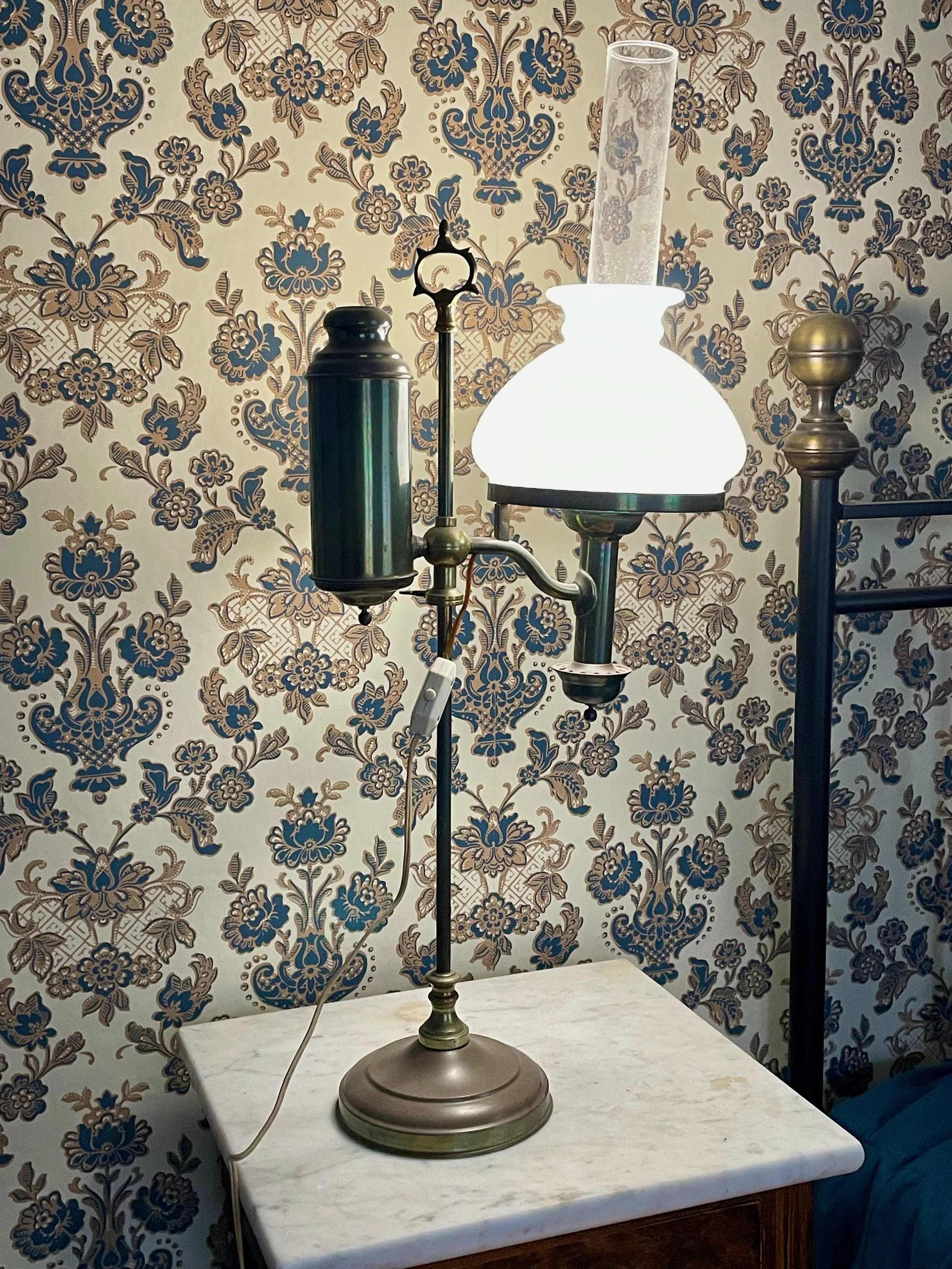
Electrified student lamp, originally from Portugal.
This asymmetrical composition is not decorative. It is deliberate.
The form is often attributed to German makers such as Wild & Wessel, whose designs combined engineering precision with refined detailing. From there, the lamp type spread widely, particularly to the United States, where companies like Manhattan Brass Company produced their own interpretations in solid brass, bringing the design into offices, libraries, and homes.
In England, it became known as the Queen’s Reading Lamp, a name that captures its essence. The offset structure allowed light to be directed downward without obstruction, illuminating books and papers while leaving the surrounding room in relative calm. It created a private sphere of clarity within a larger, dimmer space.
There is something almost architectural about it. Weight and balance are carefully resolved; function determines form entirely. And yet, the result carries an understated elegance, particularly in the interplay between polished brass, coloured glass shades, and the soft glow of flame or filament.
When this lamp found its way into Nordic homes, it did so not as a foreign curiosity, but as a natural companion. In a region where light has always been scarce and precious, its precision felt immediately relevant.
Placed on a desk, a kitchen table, or beside a favourite chair, it does exactly what it was designed to do. It creates a defined place in the room, a circle of focus, of work, of thought.
And in that clarity, it becomes timeless.